“The Beatles: Get Back” – The Lost Psychoscape and Lessons on Creativity
This post contains substantial spoilers for Get Back on Disney+.
As a person who rarely watches TV, it was very weird to observe myself being drawn irresistibly towards Get Back, the recent Disney+ documentary about the Beatles. I liked the Beatles fine but they held no truly special meaning for me. Yet something about the buzz around this series penetrated my typical anti-media force field and I became determined to watch it. I secured login credentials from a friend with a Disney+ subscription, set it up on my laptop, and within a week of release I had started watching.
The series is broken into three roughly equal parts, totaling 468 minutes. Somehow, despite this being the most hectic part of my year both work-wise and personally, with most college application deadlines falling in the first week of January and the various travel and family commitments I had made for Christmas, I managed to finish the series in a respectable seven sittings.
In this post, I attempt to answer the question: why?
In a ten-minute introduction at the beginning of part one, the entire history of the Beatles is covered montage-style, with no narration, just cut-together footage and stills presented chronologically and overlaid with simple text descriptions and accompanied by a musical track that traces the evolution of the Beatles’ music and cultural stature. I’m a sucker for a slickly-presented historical montage, and this is one of the slickest I’ve ever seen.
The magic trick, however, is that the history lesson doesn’t then cut back to a narrator in 2021 telling you what happened next. Rather, it flows naturally into a description of the situation in January 1969, clearly establishing the core conflict that will drive the rest of the story, which is that the Beatles have not performed live together in over two years, save for a film promoting their single Hey Jude that was shot with a small live audience. The Hey Jude performance apparently went so well that the band has decided to record their entire next album in front of a live audience, rather than in the studio like they were doing over the past two-plus years.
Also, for reasons relating to the schedule of the rehearsal space available to them, they have just two weeks to write and put together a live performance of fourteen new songs.
(It occurs to me that, since deadlines are very salient to me due to the seasonal nature of my job and especially during the specific time period when I watched it, perhaps the ticking clock in the background of this story helped draw me in.)
At this point (i.e., ten minutes in), I was fully grabbed, which is good because the rest of the first episode unfolds rather slowly. As a newcomer to Beatles, I spent most of it learning everyone’s faces and voices—the four Beatles, of course, but also their production team, various romantic partners, friends, and hangers-on, and the people who were there filming all of this in order to, as they thought at the time, turn it into some sort of movie. This footage actually became the 1970 documentary movie Let It Be, although Peter Jackson totally reimagined the material and used modern technology to restore the film to create 2021’s Get Back.
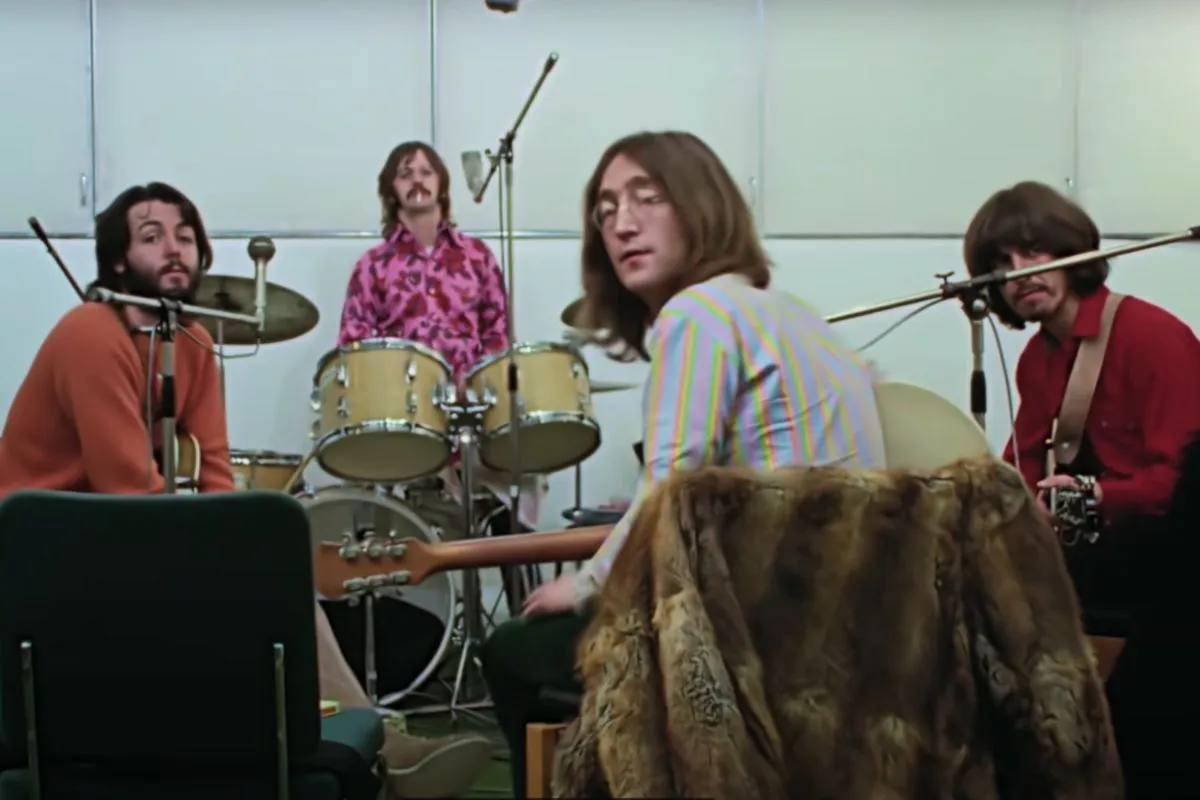
The single most notable thing about Get Back, which transcends and (both figuratively and literally) colors everything else I found remarkable about it, is the stunningly high audio-visual quality. It truly feels like traveling back in time and being in the room with these people. If you have ever watched those YouTube videos where AI is used to upscale and colorize candid black and white footage from a long time ago, it felt like that but way, way cooler.
On its own, this “time travel” effect would have been enough to keep me watching to the end. It is truly delightful. The stunning skinniness of nearly everyone (especially the young Brits born and raised during the intense poverty immediately following World War II). The totally groovy outfits. The apparently mandatory cigarette smoking. The old-school yet state-of-the-art recording and film equipment. The conspicuous absence of anything plastic, Styrofoam, or cheaply mass-produced. It’s better than any Hollywood movie set in the 60s because it’s the real thing. No continuity editor required. No chance of an accidental Starbucks cup in the shot.
The time capsule effect gets even more intense once the characters start talking and interacting. Because the film crew recorded practically everything, all day, from multiple angles, we get to watch entire conversations as they actually happened, with their natural rhythm and flow. That means a lot of times when people are sitting around chatting and there’s a lull in the conversation, unlike anything you could ever produce in a scripted film, or even most edited documentaries. And the people just kind of… sit there. Bored. This is where another aspect of the time travel effect really hit me: the people in Get Back are frequently bored. And they mostly just… sit there. No phones, no internet. They might look around, or make a silly face at the camera (John does this often, Ringo too).
That isn’t to say they don’t get distracted. The musicians and producers often get very into what they are doing and become difficult to interrupt. But that’s not very different from our lives today. What transfixed me were those small in-between moments. Ringo sitting by himself in a chair in the Twickenham soundstage because everyone else is late, just staring into space. Yoko picking at the pilling on her coat. Paul doing some questionably safe low-grade parkour on the scaffolding (he was 26 at the time of filming!). It all seems so… calm. Wholesome. Sane.
This was when I realized that I was experiencing nostalgia for a time I hadn’t lived through. This was unsettling. Yet I wasn’t nostalgic for the specific conditions presented in the film. We don’t see much of the food the people eat, but what we do see is pretty bleak, mostly white bread with various spreads and coffee and water and wine. And I don’t think I’m missing much with the ubiquitous smoking. Rather, I felt myself yearning for what I want to call the psychoscape of the moment captured in the film, that is, the gestalt of viewpoints and attitudes and expectations and habits that in 1969 was complete and self-evident and self-contained and is now, in 2022, utterly extinct.
There is nowhere you can go in the world today and experience the psychoscape that existed in 1969. Oh, sure, you can turn off your own phone and do something at home that doesn’t involve connectivity. You could even get a group of dedicated friends and do it together. But the fact is, the whole time you are doing this, you will still be operating with a brain that has been shaped by the psychoscape of 2021. You will undoubtedly reach some point in a conversation where you realize some factual question is at issue that you could easily settle with a Google search, but since everyone’s phones are off you’ll laugh it off and move on. This is a 2021 phenomenon. In 1969, no one encountering such a point in conversation would go running for the encyclopedia. Even when we unplug, we are shaped by the lives we have lived. And our lives have been completely, unrecognizably different from what was the norm for the entire twentieth century up until the 90s. It is not hyperbole to say that Get Back is a window onto a lost world.
This realization never really left my mind for the rest of the viewing experience, but it did subside enough for me to take in the story, which is compelling in its own right—quite a feat, considering that we know how it ends from the very start.
I mentioned above that I watched Get Back during what is unquestionably the busiest part of my year. However, I find this coincidence remarkable less from the perspective of time management and more from the perspective of my own peculiar state of mind in recent months. For context, I have been in the process of rewriting my first novel since March 2021, but had decided to put it on ice in September to focus completely on the college application season (i.e., my day job). Yet, I am nothing if not compulsively creative. I still thought about the book every single day. I continued to have ideas and take notes about it. I was basically being volcel but for writing my book. This was, frankly, excruciating.
Thus, when I started watching Get Back, I was totally taken in by watching the Beatles working creatively together. The experience was nothing short of creativity porn. I felt a strong yearning for the camaraderie and creative kinship the band members and producers all shared. I was also impressed by their avowed spontaneity and determination to just figure things out on the fly—especially with regards to the live concert portion of the Get Back Project, which was initially pitched to them by the producers as a huge television event at an ancient Roman amphitheater in North Africa and eventually got scaled back to a much more manageable, spontaneous, and frankly more fun illegal daytime concert on a rooftop. If there is an actionable takeaway from this part of the story, it is that there is a great virtue in not being so careful while trying to make art, not worrying so much about planning and controlling and understanding every part of how the art is “working” inside and out, when what really matters is actually making the art.
There was one other takeaway, however, that I think was even more profound. It comes up during part two, in the sequence when George has temporarily quit the band and everyone is trying to figure out what to do next. It is the day after the band members go and have a conversation with George at his home. John and Paul come into the studio and then go for lunch to talk over their options, not realizing that the film crew has placed a secret recording device in a vase of flowers on the lunch table. The conversation lays the entire conflict bare: Paul is clearly fixated on his idea that without the original four members the Beatles are not The Beatles, when John breaks in and says:
“I don’t think the Beatles revolve around the four people. It might be a fucking job.”
This, to put it mildly, blew my mind. My appreciation of John Lennon as a person and a thinker hinged almost entirely on this scene. For the rest of the film, I was strongly aware that he was the sharpest, clearest-thinking of the Beatles when it came to matters other than music. Imagine being a multi-millionaire rock star, among the most famous people alive and at the height of your creative powers, and having the maturity (at just 28 years old!) and perspective to recognize that yes, even you are a worker, subject to the structures of capitalism.
Paul, of course, was not persuaded. And George did eventually come back, so it was kind of a moot point. Moreover, John’s decision to leave the Beatles later that year is essentially what caused the group to permanently “break up.” So, in the strict sense, John was dead wrong.
Yet, in spite of that, I think he was exactly right. That is because there are actually two statements here. Did the Beatles “revolve around the four people”? History shows us that they did. But was being in the Beatles “a fucking job”? It absolutely was. And I think this has important implications for anyone who wants to do creative work.
There is nothing particularly magical about being an artist. You still have to show up, and do your work, and sell it to someone, over and over. It may seem like more fun than construction or accountancy (depending on your personality), but it’s still a form of work.
As an aspiring author, this is something I need to be reminded of again and again. Writing is certainly fun, and even feels magical at times. But if I am serious about selling books for a living, I need to approach it as a job. I need to develop the humility to view my art as (abstractly) the same sort of thing as my consulting job. If I don’t wake up on time, if I don’t keep my desk tidy, if I don’t look after my body properly, and most of all if I don’t sit down at my computer and type, then the work can’t get done. And the work getting done is step zero of the work being any good, being sold, being appreciated by others, and all the other myriad things that make being an artist more appealing than a regular job.
In summary, Get Back is simply amazing. It is amazing in its own right, as a work of documentary film-making. I can recommend it without hesitation on these grounds alone. But it was especially amazing for me, because of when and who I was when I watched it. I can’t guarantee anyone else will have that experience. Probably you won’t. But you should watch it anyway. Who knows, there may be other hidden lessons in the film that pertain to your own life and dreams.1
Footnotes
-
tst ↩